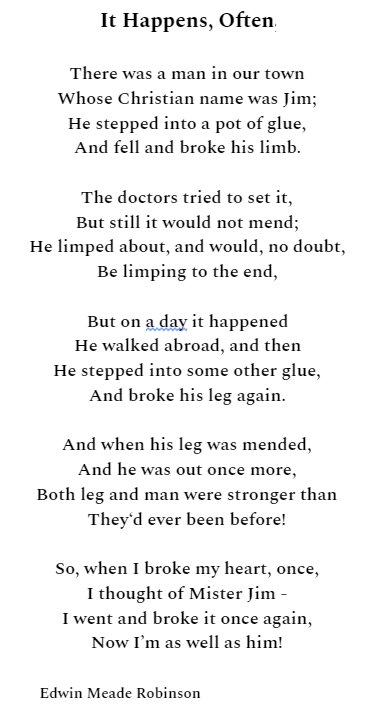
“It Happen, Often” by Edwin Meade Robinson is a poem about how people overcome their problem. It was a little lovely poem with 20 lines. It was divided into 5 stanzas, and each stanza has 4 lines.
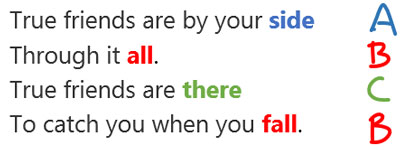
The Poet used the “A B C B” rhyme scheme for the poem, we can see this by look at each stanza. The ending of the second and the fourth lines rhyme with each other, and the opposite happens to the first and third line.

The poem was about a man whose was name and lived in the Edwin’s town. He broke his legs by mistakenly stepped into the glue pot and falling down. But eventually, his legs mended, and they were stronger than they’d have ever been. Our author sometime later experienced some events that left a bad mark on his heart. But he looked at Gentlemen Jim, and he became stronger.

Figurative languages was cleverly weaved together to form this beautiful piece of poem. We have personification, irony and imagery.
First, we have the personification. Jim’s legs was depicted as people. They mended, or healed themselves as they are human. They were hurt, but after they were healed, they became stronger as if they are human themselves. We can clearly see this in the poem on line sixth, seventh and eighth.
Our poor Jim limped and limped until the day he and his legs were healed. We can see this in our mind as we read through line seventh and eight. The poet draw a clear picture of Jim limping around in our mind using imagery.
But, the most prominent one in the poem is Irony. Take a look at our Jim. He broke his legs, but after he recovered, his leg became stronger than ever. The thing that hurt you will make you stronger. The same thing happened to our author. He was heart-broken. But he got over with it and became stronger.
That lead to the theme of the poem. The thing that hurt you, will make you stronger, no matter how hurt it would be. I can link this to myself as many time, I have fallen, and many time, have I stood up and became stronger. I wish every one can be the same.


 James' Blog
This is a great analysis of the poem, James. The personification that you have identified is “allegory”. The broken leg is an allegory for a broken heart (or personal struggles), and you are correct to assume that with each difficulty and recovery, people mature and get stronger. Great job!
LikeLike