Either you have pho, or you dont. There is not, absolutely no substitute for pho. For its uniqueness, pho has became the signature dish of Vietnam, that you can say: “you haven’t came to Vietnam if you didn’t eat a bow of pho there.”

When you come to pho, you will be suprise to find out that pho is relatively new for a country with more than 4000 years of history. Pho actually became popular in the 1880s in the French Colonial era of Vietnam, but before that, pho wasn’t make from beef, and the famous flattened-rice noddle did not exist. It was called “xáo trâu” (water buffalo and rice noddle).
However through the time, the version make with beef became more popular, as vendors then know how to remove the distinct smell that people dont like, and that became “xáo bò” (beef with rice noddle). At that time, a lot of the vendors in the local area were Vietnamese-Cantoneses, so they called them “ngưu nhục phấn”, and began to flatten the normal round-shaped rice noddle, and use the scrap beef like bones, and the part that the French don’t use.

With hot broth, smooth texture of noddle, delicious beef and fresh herb, the dish won out Vietnameses, Chineses and even the Frenchs who lived and worked in big cities like Hanoi.
So, how did “ngưu nhục phấn” became “phở”? For the sake of being competitive, vendor started to abbreviate the name from “ngưu nhục phấn đây” (beef and rice noddle here) to “ngưu phấn a”. However, it’s still too long. So, people keep shorten the name to “phấn a” or “phốn ơ” before settled in the name that we all know and love: PHỞ.

Despite all of that Vietnamese – Chinese debate, the dish could even be associated with the French, as in “Pot-a-feu” (broiled beef dinner). Although many see the resemblances of the two are slim, as we don’t put vegetable into the broth and cook it together like the French, but it’s still plausible for a Vietnamese-French variation of the dish to became the pho we known and loved.
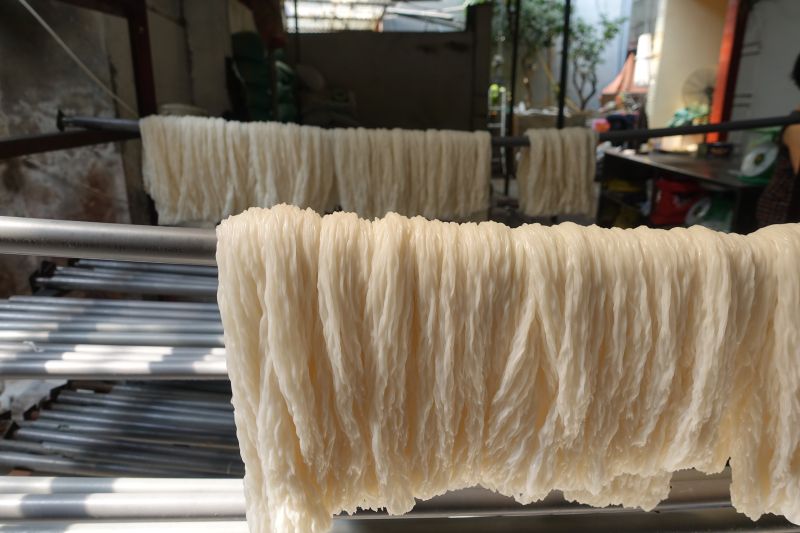
The name “phở”, does not only refer to “phở” itself. It also used to talk about the noddle, or what we call: “bánh phở” (phở noddle). For it’s uniqueness, it’s rewarded with an unique fitting name. The texture… you will have to try it yourself.

As time when on, variations of pho became more popular. Like “phở gà” (chiken with phở). The beef in the original phở is replaced with chicken. The broth instead of using beef bones to slow cook, the chef uses whole chickens to make them.
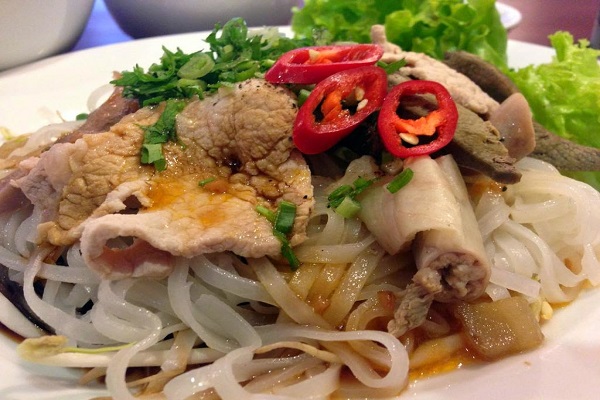
Another version is “phở xào giòn/dòn” (pan-fried phở), where you cook both “bánh phở” and all of it’s components is, as the name said, pan-fried and serve with hot sauce, and black bean sauce.
Even between the two largest cities of Vietnam (Hanoi and Saigon, or Ho Chi Minh City), there are many differences between Hanoi’s phở and Saigon’s phở. Some even step out of the normal boundaries and give Phở a different look, like using seafood instead of beef and chicken.
For it’s uniqueness and it’s many variation, phở has always had a special place in the Vietnamese culture. Everytime you eat a bow of Phở, remember that it’s a dish that carry three seemingly different cultures in it. And that’s why, you have never truely been too Vietnam, if you don’t at least try a bow of phở there.
Source Cited:
Nguyen, Andrea, et al. “The History of Pho.” Viet World Kitchen, 18 May 2018, https://www.vietworldkitchen.com/blog/2018/03/the-history-of-pho.html.
Adam, Barbara. “The Many Faces of Pho.” Medium, Invironment, 12 Apr. 2016, https://medium.com/invironment/the-many-faces-of-pho-2b778ed04c7d.
 James' Blog